|
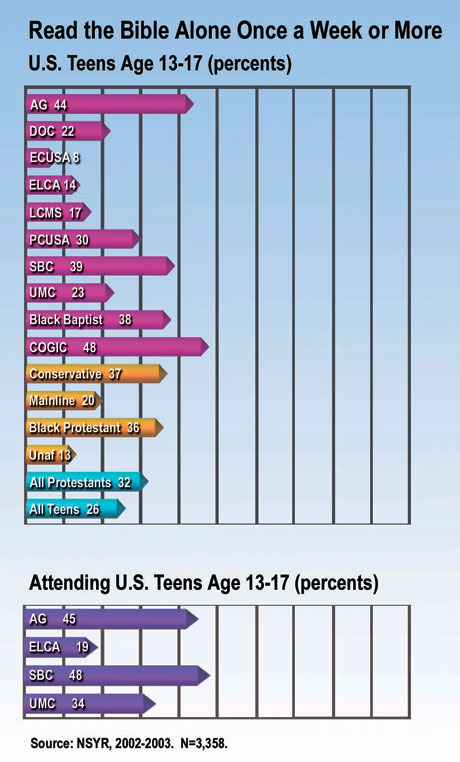
Few U.S. Protestant Teens Regularly Read the Bible View printer-friendly version [PDF] Fewer than one-third of all U.S. Protestant teenagers (32 percent) report that they personally read the Bible alone once a week or more often, according to researchers with the National Study of Youth and Religion. The majority of U.S. Protestant teenagers say that they read the Bible either less frequently or not at all. Furthermore, of all U.S. teenagers, only about one in four reads the sacred scripture of their religious tradition weekly or more often (26 percent). Large numbers of U.S. teenagers do claim religious affiliations and report attending religious services. But the findings here suggest that far fewer U.S. teens regularly engage in more personal religious practices of faith — like scripture reading — that many religious traditions, especially Protestantism, have long emphasized as crucial for spiritual growth. The National Study of Youth and Religion (NSYR) is based at the University of North Carolina at Chapel Hill. The exact NSYR survey question wording for this item as asked of Protestant teenagers was: "How often, if ever, do you read from the Bible to yourself alone?"
Note: The above list is grouped by the religious tradition of the parent. AG= Assemblies of God, DOC=Disciples of Christ, ECUSA=The Episcopal Church USA, ELCA=Evangelical Lutheran Church in America, LCMS=Lutheran Church Missouri Synod, PCUSA=Presbyterian Church (U.S.A.), SBC=Southern Baptist Convention, UMC=United Methodist Church, COGIC=Church of God in Christ, Unaf=Unaffiliated. "Most religious traditions teach that faith and spiritual maturity does not happen automatically, but that these must be intentionally cultivated and practiced," stated Dr. Christian Smith, principal investigator of the study. "Just as becoming good at sports or playing a musical instrument requires consistent practice, living well a life of faith also requires practice — that is what most religious traditions have always taught. But these findings suggest that only a minority of U.S. teens are getting much practice at faith in the form of scripture reading." Smith also noted, however, that it should not be assumed that U.S. adults read the Bible or other scriptures any more regularly than do teenagers: "It could be that most Protestant adults are not very good role models for their teenagers when it comes to basic, personal religious practices like reading the Bible." Smith is Stuart Chapin Distinguished Professor and associate chair of sociology at the University of North Carolina at Chapel Hill. Regular Bible reading among U.S. Protestant teens varies by the religious tradition and denomination of their parents, according to these NSYR survey findings. In general, teens with conservative Protestant and black Protestants parents tend to read the Bible more frequently (37 and 36 percent, respectively) than teens with mainline Protestant parents (20 percent). Focusing on specific denominations, at the lowest end, only 8 percent of teenagers of Episcopalian (ECUSA) parents report reading the Bible alone once a week or more often. By contrast, 44 percent of teens with Assemblies of God parents and 48 percent of teens with Church of God in Christ parents read the Bible once a week or more often. In some denominations, as might be expected, teens who attend church services regularly are also somewhat more likely to read the Bible by themselves alone regularly. But that difference is smaller than many might expect. For example, among teens in the Evangelical Lutheran Church in America (ELCA), only 5 percent more of regularly church-attending teens read the Bible weekly or more often than do all ELCA teens (19 percent compared to 14 percent). These findings about U.S. Protestant teenage Bible reading are one small preview sample of a much larger body of findings about the religious and moral lives of U.S. Protestant teenagers scheduled to be published by the NSYR in early 2026. Interested readers can sign up at the NSYR website youthandreligion.org to receive notification of that report's publication. The National Study of Youth and Religion is funded by Lilly Endowment Inc. More than 3,350 teens along with one of their parents participated in the random-digit-dial telephone study of U.S. parent-teen pairs. The purpose of the project is to research the shape and influence of religion and spirituality in the lives of U.S. adolescents; to identify effective practices in the religious, moral and social formation of the lives of youth; to describe the extent to which youth participate in and benefit from the programs and opportunities that religious communities are offering to their youth; and to foster an informed national discussion about the influence of religion in youth's lives to encourage sustained reflection about and rethinking of our cultural and institutional practices with regard to youth and religion. 06-23-04 |
 |
 |
 |
 |
||||||||||||||||||||||||
|
|

|
|||||||||||||||||||||||||
 |
|
||||||||||||||||||||||||||
 |
|||||||||||||||||||||||||||